Emergence of new states
Regional Powers
(1) Independent states
(2) Successor states (Awadh, Bengal and Hyderabad)
(a) Bengal
(b) Awadh
(c) Hyderabad
(3) New states (Rebel states)
(a) Maratha (Cause of revolt was Religious)
(b) Sikh (Cause of revolt was Religious)
(c) Jat (Cause of revolt was Revenue)
Sikh :-
- means learning
- It was started in the form of Socio-Religious Reform Movement
- It was based on Guru and Shishya tradition
- Guru-Shishya / Pir-Murid / Guru-Disciple
- First Sikh Guru - Guru Nanak Dev Ji (Founder of Sikhism)
- Major Feature: - Humanity
- In Sikhism, Guru Nanak Dev Ji believed in formless God.
- He followed Nirguna Bhakti.
- He promoted equality in the society.
- He criticised discrimination in each form.
- He challenged Untouchability
- He empowered women
- He criticized ideal worship
- He promoted Humanity as best teacher and serve the human was equal to serve the God.
- The Sikhism was continued with Guru-Shishya tradition
- There were total ten Gurus and one Guru Granth Sahib in Sikhism
(1) Guru Nanak Dev Ji - Founder of Sikhism
(2) Guru Angad Dev Ji - introduced Gurumukhi Script
(3) Guru Amardas Ji
(4) Guru Ramdas Ji - Founder of Golden Temple, Amritsar
(5) Guru Arjandev JJi - Compiled Adi Granth
(6) Guru Hargovind Ji - started giving Military Training to Sikh followers
(7) Guru Harrai Ji
(8) Guru Harkishan Ji
(9) Guru Tegh Bahadur Ji
(10) Guru Govind Singh Ji - organised Sikh Community and formed "Khalsa" panth
(11) Guru Granth Sahib Ji - The responsibility of its protection and management was given to "Banda Bairagi" (favourite disciple of Guru Govind Singh Ji). He was popular as "Banda Bahadur"
Khalsa Panth :-
- It was propounded by Guru Gobind Singh Sahib
Five K :- Kesh, Kangha, Kara, Kirpan, Kachcha (Kachera)
- (1) Kesh symbolizes natural state of being
- (2) Kangha symbolizes cleanliness
- (3) Kara symbolizes readiness, strength
- (4) Kirpan symbolizes protective nature to help needy
- (5) Kachcha (Kachera) symbolizes self-respect, morality & Ethics
Akal Takhta :-
- Akal Takhta means "Throne of timeless One"
- There are total 5 Akal Takhtas in Sikhism
- (1) Akal Takhta - Amritsar (Punjab) - The supreme takhta established by Guru Har Gobind Sahib
- (2) Takhta Shri Keshgarh Sahib - Anandpur (Punjab) - Birthplace of Khalsa Panth
- (3) Taskhta Shri Patna Sahib - Patna (Bihar) - It is known as the birthplace of Guru Gobind Singh Sahib
- (4) Takhta Shri Hazuri Sahib - Nanded (Maharashtra) - Known for the place of death of Guru Gobind Singh Sahib
- (5) Takhta Shri Damdama Sahib - Talwandi (Punjab) - It is known for the place where Guru Gobiond Singh Sahib declared Guru Granth Sahib as final Guru
Formation of Sikh State
Socio -Religious Reform Movement --- Sikh Religion --- warrior class/community --- State
- Warrior class responsibility was to protect the needy and the poor. These warrior class converted into small and strong bands. After that they decided to establish self-gained political powers and there emerged 12 groups called " Misla" which led to form 12 Chieftains and they decided to meet once in a year or in some festival occasion to discuss about the Sikh Community and take decisions on majority basis. Among these the most powerful Misla was "Sukarchakiya Misla". The name of the head by Maharaja Ranjeet Singh.
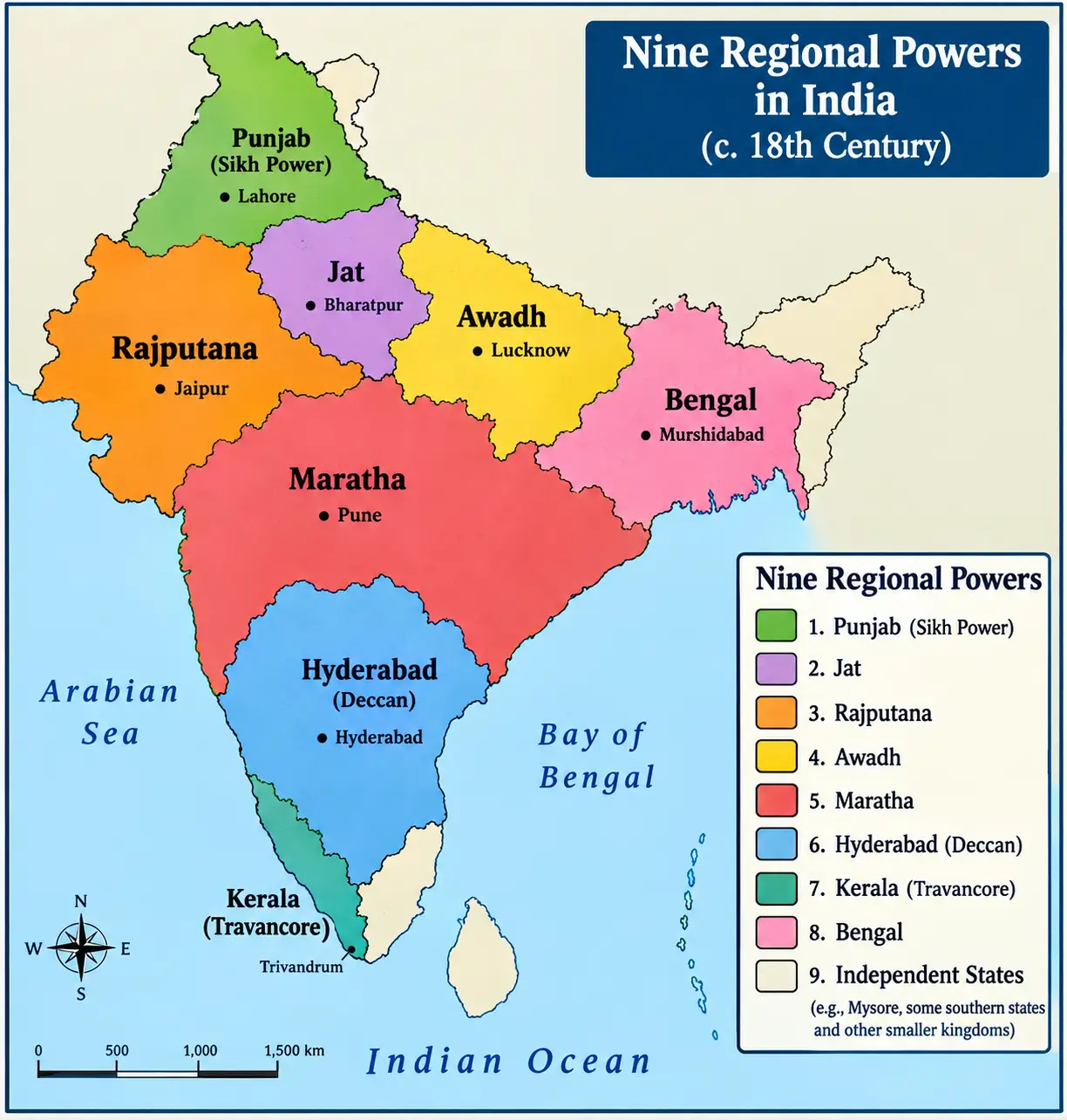
Jat State:-
- The Jat State emerged in the surroundings of Delhi, Agra region
- Major Center - Bharatpur (Rajasthan)
- Reason - It emerged as a rebel state against the revenue system of Mughals
- It was founded in 1695 A.D.
- Major Rulers;-
- (1) Churaman Jat (Founder)
- (2) Badan Singh
- (3) Surajmal Jat
Successor States :-
- It included those states which were earlier Mughal Provinces (part of Mughal Empire) but later they declared themselves as a Separate Regional Power.
- In this category Bengal, Awadh and Hyderabad were the important powers.
Bengal :-
- Located :- The Bengal Province of Mughal Empire consisted of the area of Bihar, Jharkhand, Bengal, Bangladesh, Odisha and some parts of North-East India (known as Assam)
- Economic Condition :- it was considered as most prosperous Province of Mughal for its Agriculture (fertile region) and Trade (Handicraft Industries, Trade, Ports)
- Bengal collected maximum revenue of that time
Bengal as a Separate Regional Power: -
- Bengal separated itself from the time period of Farrukshiyaar in 1717 A.D.
- Murtshid Quli Khan declared it / separated it as a Regional Power
Important Nawabs of Bengal :-
(1) Murshid Quli Khan (1717 - 1727 A.D)
- Earlier he belonged to a Brahmin family
- His name was Surya Narayan Mishra
- He was converted Muslim - Muhammad Hadi
- During the reign of Aurangzeb, her was appointed as Diwan of Hyderabad in 1698
- Aurangzeb gave him a title of Murshid Quli Khan
- Later he was appointed as Faujdar, Diwan of Bihar by Aurangzeb and finally in 1717, he was appointed as Subedar of Bengal
- After becoming Subedar he had conflict of interest with BEIC and Mughals
- He shifted his Capital from Dhaka to Murshidabad
- He introduced a new revenue system to reform in the economy
- Revenue Reform: - Mal Jasmani (MalZamini)
- He introduced strict laws for European Companies. He was not in the favour of Mughal Farman which was given to BEIC
- He restricted fortification and Nawab's permissions were made compulsory
- He implemented Secular policy in Administrative Appointments
(2) Shuja-ud-din (1727 - 1739)
- His son was Sarfaraz Khan
(3) Aliwardi Khan (1740 - 1756)
- He is considered as the real Founder of Bengal
- He provided Bengal complete autonomy and independence from Mughals
- He was considered as one of the most capable Nawab of Bengal
- He acquired the power by overthrowing of Sarfaraz Khan (son of Shuja-ud-din)
- He implemented strict policy against BEIC
- He expanded the territories of Bengal
- His reign also known for attacks of Marathas (Balaji Baji Rao) on Bengal. He had to face defeat and agree to pay "Chauth" (1/4th of the total production)
(4) Siraj-ud-daulah (1756 -1757)
- He was the last independent Nawab of Bengal
- He had direct confrontation with BEIC
- He objected the fortification of Fort William
- He gave a warning to BEIC
- Not to misuse Dastak (Signature)
- Not to fortify Calcutta
- But his warning was ignored intentionally
- He decided to punish BEIC
- He seized Calcutta and attacked on Britishers
- He captured around 146 Britishers in a small room / chamber of 20X20 ft. dimension
- Among these 146, only 23 survived and remaining 123 had died overnight due to suffocation
- This incident is known as The Black Hole Tragedy of Bengal (20th June 1756)
- Those who survived, reached Fulta Tapu and informed Madras for help
- The naval force of Madras marched towards Bengal
- They started conspiracies against the Nawabs with the support of Nawab rivals in the Court
Major Conspirators of Nawab
(1) Mir Jafar (Commander-in-Chief) and his son Mir Miran
(2) Ghasiti Begum (maternal aunt)
(3) Seth Amirchand (rich merchant class)
(4) Jagat Seth (powerful moneylender)
(5) Rai Durlabh (military-in-charge)
(6) Seth Manikchand (rich merchant class)
Battle of Plassey (1757 A.D.) (23rd of June 1757)
- Nawab of Bengal (Siraj-ud-Daulah) Vs. BEIC (Robert Clive)
- Result: - In the battlefield Rai Durlabh and his force stepped back in Battlefield
- Siraj-ud-Daulah was defeated and had to flee from there
- He was followed by Mir Miran and killed
- He was identified by Dana Shah (Fakir) and his information was shared to Mir Miran who killed him
(5) Mir Jafar (Zafar) (1757 -1760 A.D)
- He was the first puppet Nawab of Bengal
- He supported BEIC to defeat Siraj-ud-Daulah
- In return of Nawabship, he paid a huge amount of around 1.7 Crore rupees to BEIC
- He also gave Zamindari of 24 pargana (region)
- He came to be known as "Gaddar-e-Abrar" who played a key role in ending the independence of India
- The BEIC tried to extract more and more benefits from him
- They were not satisfied with the new Nawab, so they replaced him by Mir Qasim
(6) Mir Qasim (1760 -1763 A.D)
- Mir Qasim became Nawab with the support of BEIC
- He tried to restore the power of Nawabship
- He shifted his capital from Murshidabad to Munger
- He made the trade free for Bengal traders also
- This step of him agitated the BEIC as they had lost their special right
- He started training his forces on European standards and established manufacturing units / companies of gun and fire locks in Munger
- This resulted into conflict with BEIC
BEIC replaced Mir Qasim by Mir Jafar (Zafar)
(7) Mir Jafar (Zafar) (1763 - 1765 A.D)
Battle of Buxar (1764 A.D)
- Took place between combined force of Bengal (Mir Qasim), Awadh (Shuja-ud-daulah) and Mughal (Shah Alam II) Vs. BEIC (Won)
- Before Battle of Buxar a series of battle also took place between Mir Qasim and BEIC
- Battle of Katwa, Murshidabad, Giria, Sooty and Munger
* BEIC called Robert Clive to formulize a treaty which came to be known as "Treaty of Allahabad" (1765 A.D)
- This Treaty established Dual Rule in Bengal
Awadh :-
- Located in area of Uttar Pradesh near Gangetic Plain where the region was fertile and as a result agricultural production was high resulting in high revenue
- Agricultural - Raw material-based industries was more resulting in high revenue
- Awadh separated itself in 1722 in the period of Muhammad Shah
- Awadh was established by "Sadat Khan Burhan-ul-Mulk"
- Awadh was divided into five geographical divisions namely Ayodhya, Lucknow, Behraich, Gorakhpur (East), Khairabad (West)
- Izaradari System affected this region severely as the peasants were exploited for more and more revenue. So Awadh had to face Revolts.
- After becoming a separate regional power, Burhan-ul-Mulak prohibited Izaradari and took some Reform initiatives.