Introduction to Modern History
Firstly we will look into the division of Indian History. What does history mean?
History means the study of past events / study of changes.
Changes refers to multidimensional changes.
Changes in Polity
Changes in Economy
Changes in Society
Changes in Culture
India’s Past [Pre-historic to Present Day]
We arrive at two important questions.
(1) Why study of India’s past was required?
(Ans1) (a) To know about India and the mindset of Indians and so they translated India’s Literature.
(2) How did the history of India was divided?
(Ans2) They divided India’s past on the basis of religion.
Division of India’s History according to British HIstorians (Historiography:- reconstruct the past events):-
This is called the Separatist Approach was promoted by Europeans Historians. Indian historians (Nationalist) Bipan Chandra/Vipin Chandra opposed this division.
Latest:- Modern Time/Rule (British)
Middle:- Muslim period
Early:- Hindu period
Afterwards it was divided into:-
(a) Ancient history (Pre-historic – 1200)
(b) Medieval history (1200 – 1750)
(c) Modern history (1750 – 1947)
Colonization can be divided into three phases:-
Phase 1:- Economic Supremacy
Phase 2:- Political Establishment
Phase 3:-Culturization
Culturization means that all the resources (natural & human) be utilized for the benefit of Britain (Motherland). Culturization can be achieved by promoting education (thought) and religion (ideolgy).
History of Modern India:-
(1) History of Colonial period in India
(2) History of India’s struggle for Independence or Nationalism
India’s share in World GDP in Medieval period:-
(1) Around 1700:- 24.27%
(2) Around 1947 A.D.:-3%
(3) Around 2026 A.D.:- 8%
Modern Indian History:-
1750 AD to 1947 AD
Middle of 18th century is known for establishment of British Rule in India.
(1) 1707-1757:-
(a) Situations in India
(b) Later Mughals
(c) Rise of Regional Powers
(2) 1757-1857
(a) 1757:- Battle of Plassey. Establishment of Political power which led to formation of new policies. (Administrative/Political, Revenue Policies)
Revolts:- Peasants Revolt, Tribal Revolt, 1857 Revolt
(b)1857:- Revolt of 1857/First war of Independence.
(3) 1857-1885
(a) Acts
(b) INC and their important sessions
(4) 1885-1947
(i) 1885-1916
(a) 1885-1905
Liberal Phase led by INC (Indian National Congress)
(b) 1905-1916
Extremist Phase (Bipin Chandra Pal, Lala Rajpat Rai, Lokmania Bal Gangadhar Tilak)
(ii) 1917-1947
Gandhian Phase:- Movements and Important Events
Situations of Europe:-
Situations/Factors which led the arrival of European companies towards Asia and India through New Routes.
India was connected with Europe through trade from Ancient Period.
Ancient Period – Silk Route & Sea Route
Medieval Period – (a) Land Route [1]
(b) Sea Route [2]
Modern Period: – Sea Route through Atlantic Ocean
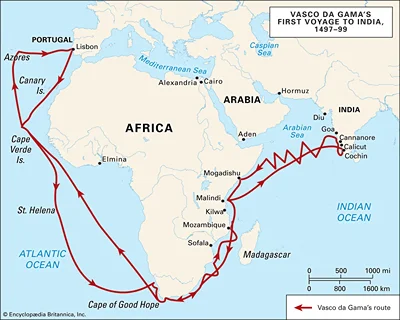
When they reached Malindi, an island in Kenya, Abdul Majid & Kanji Malam supported Portuguese to reach India. They gave knowledge regarding the weather of Arabian Sea, its current and sea route.
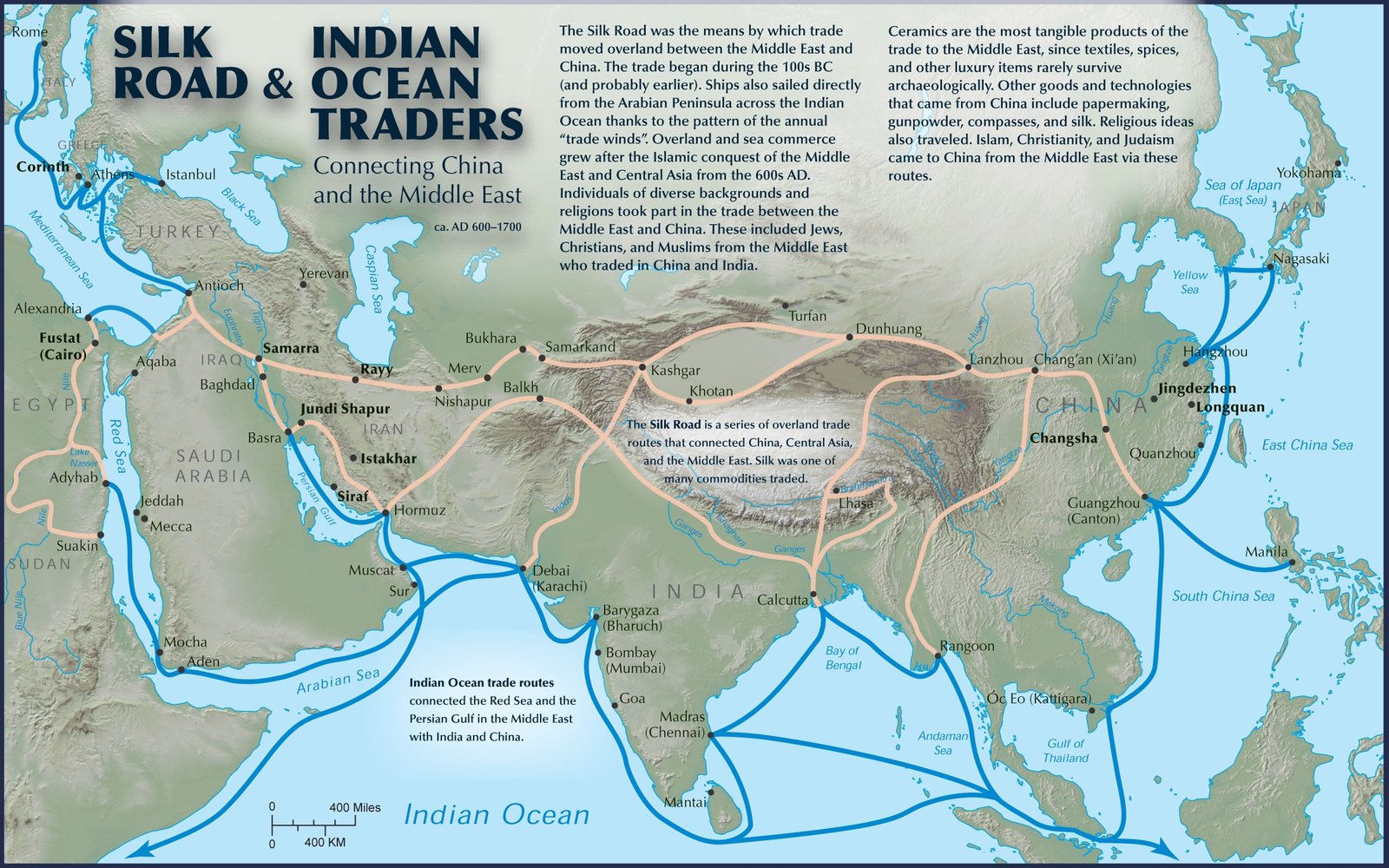
Three (3) major trade Route between India [Asia] and Europe:-
(1) Land Route: – India [N-W Side] —– Central Asia —– Russia —– Baltic Nations
(2) Sea Route
(a) India —— Persian Gulf —– Turkey —– Mediterranean Sea —— Italy
(b) India —— Red Sea ——- Egypt —— Mediterranean Sea ——- Italy