Charles Dickens: A Tale of Two Cities
Introduction To a Tale of Two Cities (1859)
Today we'll talk about a famous novel by a Victorian novelist Charles Dickens titled A Tale of Two Cities. So before we talk about the summary, let me give you a brief background of the novel. This novel tells a historical story set in two cities, Paris and London, at the time of the French Revolution. The novel opens with the words, "It was the best of times, it was the worst of times" The story revolves around the events that happened before and during the French Revolution. The hero, Sydney Carton, can be best described as a romantic hero with a weakness.
The book is divided into three books,
(i) Recalled to Life
(ii) The golden Thread
(iii) The Track of a Storm.
Book 1: Recalled to Life: Letter
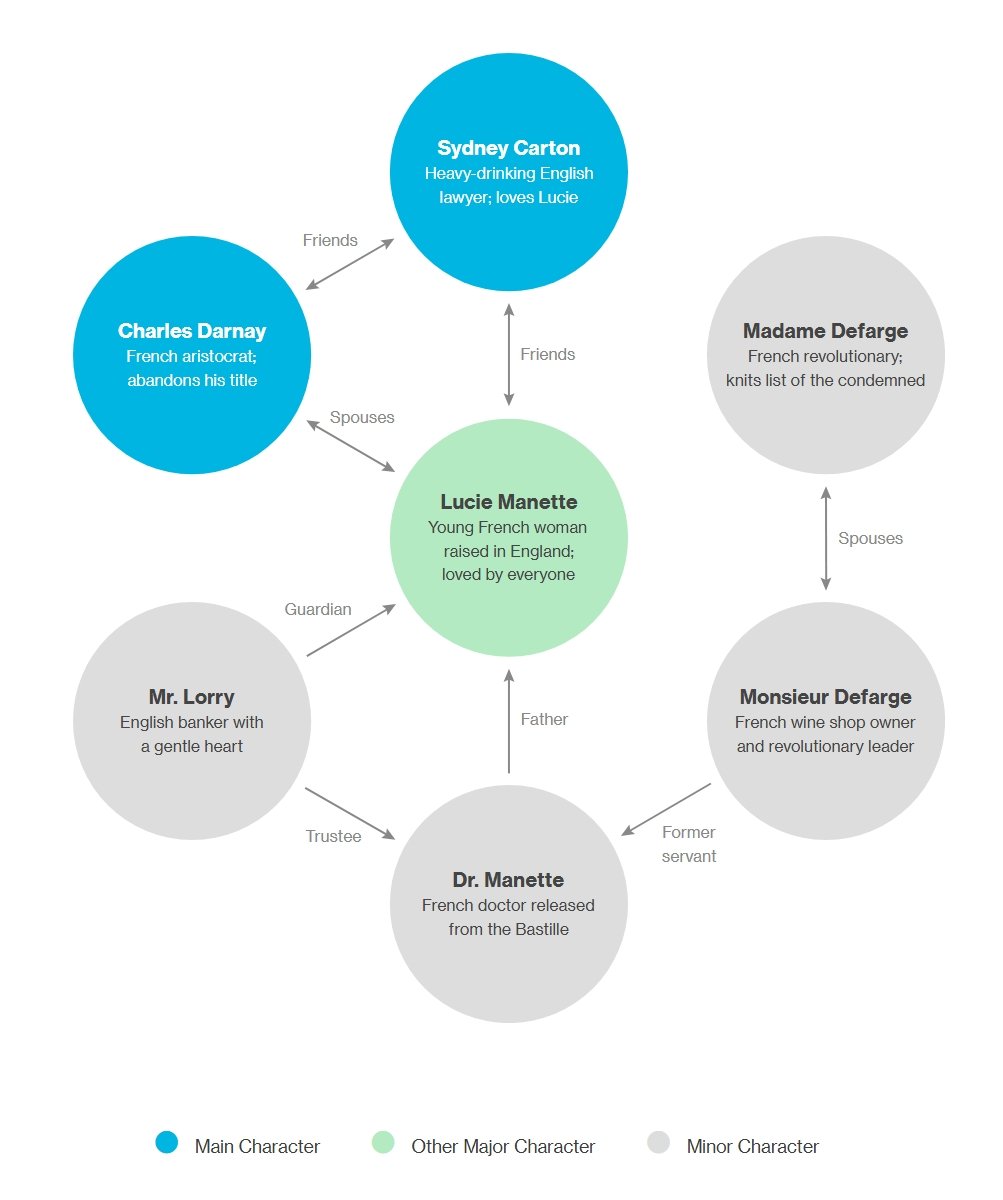
The story starts in the year 1775 with Mr. Jarvis Lorry, the manager of Tellison's Bank in London. He receives a letter instructing him to find a young woman named Lucie Manette. Lorry responds to the letter with the words, recalled to life, and does not explain it further. Then he goes to Dover to meet Lucie Manette, a young girl who thinks that her father, a noted doctor, Dr. Alexander Manette, is dead. She is shocked to learn from Lorry that her father is alive and has recently been discovered in France. Lorry takes Lucie to Paris to reunite her with her father.
Section 1: Find Lucie's Father
Now moving to the first section. In Paris, they meet a former servant of Dr. Manette named Ernest Defarge and his wife, Therese. He has kept Dr. Manette safe in the attic of his home. Lorry and Lucie arrive at the attic to see Dr. Manette obsessively making shoes. Defarge explains to them that driven mad by 18 years of imprisonment, shoemaking is a hobby that Dr. Manette learned while in prison. Lorry assures Lucie that her love and devotion will recall her father back to life and take him back to London.
Section 2: The Trial
Moving to the second section, the trial. Here the story starts from the year 1780 with Lucie and Dr. Manette watching a court proceeding in London. A French emigrant, Charles Darney, is on trial for betraying the British monarchy. Two British spies, John Basard and Roger Cly, testify against him in the court. Darney's lawyer helps prove his innocence by pointing out that Basard's colleague, Sydney Carton, looks a lot like Darney himself and might as well be the real criminal. So Lucie sympathizes with Darney, which makes Sydney Carton hate him.
Section 3: The Murder
Moving further, we'll talk about the murder now. Darney is the nephew and heir of Marquis St. Evremonde, a much-hated man. He believes in repressing the poor and is very cruel. So, on his way to meet Darney in London, he orders his carriage to be driven by very fast through the crowd, killing a child in the process. He shows no regret. Instead of compensation, he motionlessly throws a coin to the child's father, which is flung back at him. So, due to these habits, views, lifestyles and treatment of the poor, Darney hates his uncle and his whole aristocratic family, which is why he does not use his actual surname Evremonde, but uses Darney. He breaks all connections with Marquis that night, and that night, Marquis is murdered in his sleep. Now, the murderer leaves a note behind signed as Jacquis, which was nicknamed adopted by French revolutionaries. After being on the run for almost a year, the murderer is finally caught and hanged to death.
Section 4: Planning Revolution
Now, year passes and the story moves forward. British spy John Basard comes to the wine shop owned by Ernest Defarge in Paris. The Defarge's are planning to start the revolution and overthrow the French King. Basard gives them the evidence and Mrs. Defarge secretly makes a list of all those whom the revolution seeks to kill.
Section 5: Marriage
Now, we'll talk about the marriage. In London, Sydney Carton confesses his love to Lucie but realizes that she does not love him and sacrifices his love for her. Then Darney asks for her hand in marriage to Dr. Manette. He agrees and they get married. Darney then unexpectedly reveals his real name and family background to Dr. Manette, as a result of which he goes back to his old habit of obsessive shoemaking. So, this whole incident is kept a secret from Lucie and she goes on a honeymoon with Darney. Upon return, they are visited by Carton, who asks Darney for his friendship. Darney happily agrees. So, in the coming years, Darney and Lucie have a son, who dies in childhood, and then a daughter, Lucie. So, little Lucie is especially fond of Carton and Laurie too lives with them.
Section 6: Revolution
Now, the revolution story moves forward to 1789, when the peasants, led by Defarge's, Dr. Manette's old servant, in Paris, march to the Bastille, and the French Revolution begins. Mr. Defarge checks Dr. Manette's old jail cell thoroughly, and among many people associated with aristocracy, Marquis Evremonde's servant, Gabelle, is imprisoned. He writes a letter to Darney, requesting him to rescue him. So, without, you know, even telling his family about his connection with Evremonde, Darney immediately leaves for France.
Section 7: Darney gets arrested
Now, Darney gets arrested. So, as soon as he comes to Paris, he is arrested by the French revolutionaries as an emigrant. He remains in his prison for more than a year, before Dr. Manette, Lucie, her daughter, her maid, Miss Pross, and Carton, they arrive in Paris to save Darney. At first, upon request of Dr. Manette, who himself was a former prisoner of Bastille, the revolutionaries free Darney, but then he is arrested again, on the same night. So, this time, the allegations have come from Mr. and Mrs. Defarge.
Section 8: The Trial
At Darney's trial, Defarge presents a letter that is discovered in Dr. Manette's old jail cell. The letter is the reason of Darney's arrest. Now, let us look what was written in that letter. Years ago, Evremonde brothers, i.e., Darney's father and uncle, they took Dr. Manette's assistance in taking care of a woman they had framed, and her brother, that they had stabbed seriously. So, after Dr. Manette took care of them, the Evremonde brothers got him arrested to keep what they had done a secret. So, since Darney was a descendant of those criminals, Defarge explained that this is why he was arrested. So, Darney is now sentenced to death within 24 hours.
Section 9: The Help
Now, that night, Carton goes to Defarge's wine shop and overhears Mrs. Defarge's plan to kill Lucie and her daughter as well. He also learns the reason for Mrs. Defarge's vengefulness and anger. She is the surviving sibling of the man and woman brutally murdered by the Evremonde brothers. Carton immediately arranges for the escape of Lucie's whole family. To free Darney, Carton gets help from John Bassett, who turns out to be Miss Pross's long-lost brother, Solomon Pross. To be safe in Paris, Bassett was pretending to be a Frenchman. So, Carton threatens to reveal his true identity and get him captured. Afraid, he agrees to help free Darney.
Section 10: The Exchange
Next up, the exchange. Now, Carton goes to the prison to meet Darney, tricks him into exchanging clothes with him, and drugs him unconscious. Bassett carries Darney, disguised as Carton, to a carriage and sends him off to London with Lucie, their daughter, and Dr. Manette. Mrs. Defarge goes to capture Lucy and her daughter, only to find a servant, Miss Pross, in the house. A fight happens and Mrs. Defarge accidentally kills herself with her own gun. Meanwhile, Carton, disguised as Darney, is taken away to the guillotine for his execution. Carton happily dies, knowing that his death is for good cause and would bring a better future for those who survive and the next generations. And thus, the story has a bittersweet ending. Not a completely happy ending. I mean, the family is united, but Carton had to lose his life for the same.
Section 11: Facts and Quotes
Now, some facts and quotes, friends. It was published in weekly installments. A Tale of Two Cities was published in weekly installments from April to November 1859. And the novel was inspired by Dickens' own experiences of visiting Paris and witnessing the aftermath of the French Revolution. The novel's famous final words, spoken by Carton, It is a far, far better thing that I do than I have ever done. It is a far, far better rest that I go to than I have ever known. They have become iconic.